

The Manufacturing Partnership Days 2025 – What a success!
29.10.2025
News
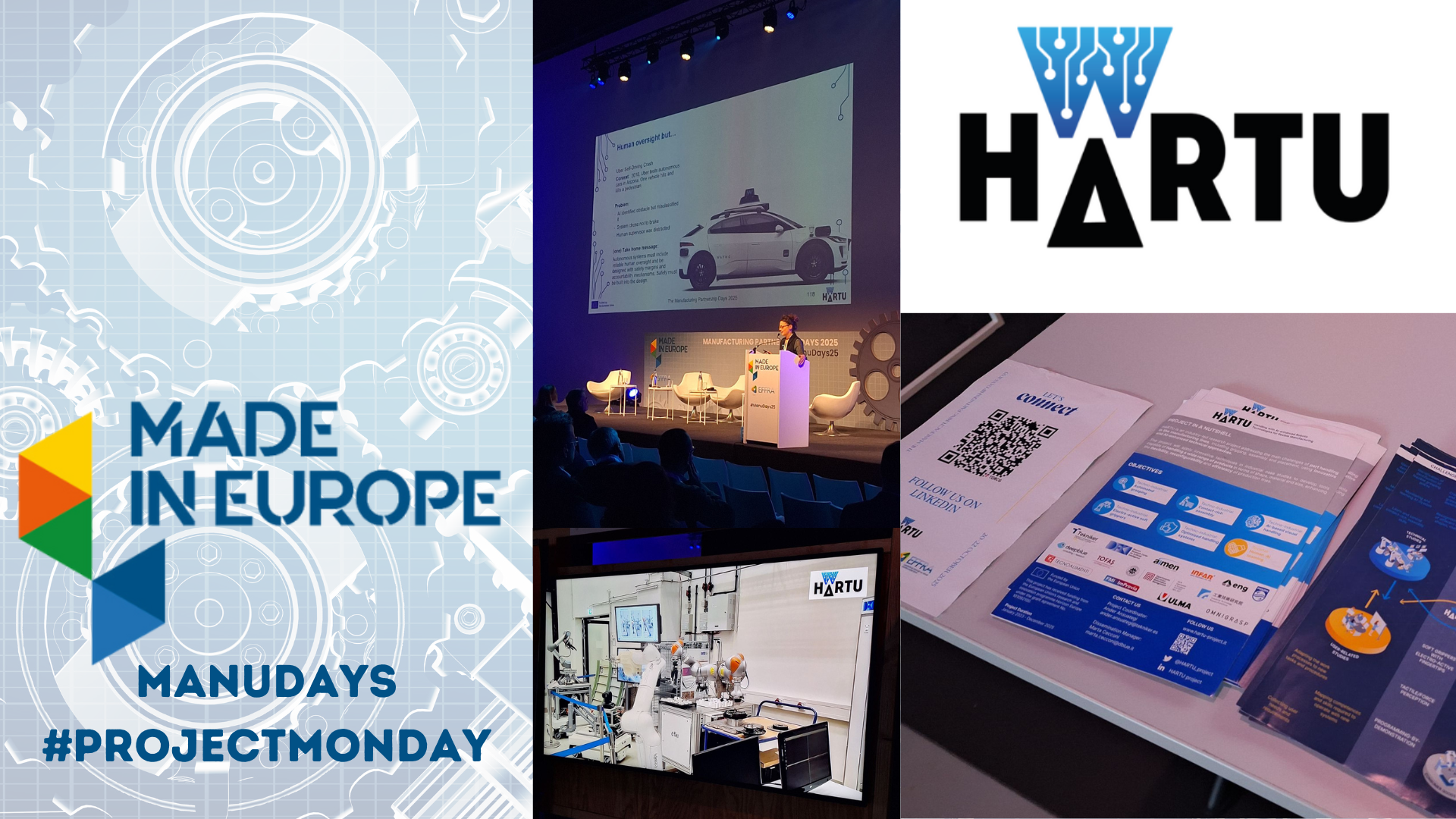
The third edition of the Manufacturing Partnership Days 2025 was a remarkable success, bringing together nearly 300 participants, 32 project sessions, 31 exhibition booths, and 7 panel discussions over three days of inspiring exchange and collaboration.
Once again, the event demonstrated the vitality, creativity, and cohesion of the Made in Europe community, showcasing how European research and innovation in manufacturing continue to drive competitiveness, resilience, and sustainability.
EFFRA extends its sincere thanks to all speakers, exhibitors, and participants . Your expertise, energy, and enthusiasm made this year’s event an engaging experience for everyone involved.
Day 1: Setting the Vision – The Future of European Manufacturing
The opening day set a strategic tone for the future of European manufacturing under the next framework programme (FP10).
In the session “The Future of EU Manufacturing Partnership”, Zeljko Pazin (EFFRA), Marco Taisch (POLIMI), and Riikka Virkkunen (VTT) underlined that Europe’s industrial strength will depend on a clear policy vision, inter-partnership collaboration, and empowerment of SMEs through digital tools. Artificial intelligence, data-driven manufacturing, and dual-use innovation were identified as key enablers of competitiveness and industrial autonomy.
The following panel, “The Future of Manufacturing Industry in the (Gen)AI Era”, addressed how Generative AI is reshaping production. Speakers from AIRISE, WASABI, AIREDGIO, and CIRCULOOS agreed that AI will not replace workers but transform their roles, emphasizing the need for mentoring, high-quality data, and institutional support from Digital Innovation Hubs.
As one speaker noted, “Possessing AI is easy managing the transition is the real challenge.”
Project presentations:
- Converging: Nikos Dimitropoulos, LMS
- Modapto: George Triantafyllo, ATC
Day 2: Driving the Circular and Sustainable Transition
The second day focused on sustainability and the circular economy as drivers of industrial transformation. With a keynote speech by Marina Zanchi, Director of HaDEA.
In “Future-Fit Manufacturing – R&I Driving the Circular Shift”, experts from Aachen University, NTNU, and the European Commission (HaDEA) discussed how EU-funded projects provide the framework for testing and scaling circular business models. Yet, despite wide recognition, adoption remains limited, with only a handful of SMEs fully embracing circular principles.
Speakers called for visual KPIs, pilot systems, and top-management engagement, reminding that “sustainability must become a profitable strategy, not a compliance exercise.”
The final session, “Paving the Way for Greener Manufacturing in Europe and Worldwide”, featured contributions from KU Leuven, STIIMA-CNR, LMS, and the European Environmental Bureau.
Discussions highlighted the shift toward ecosystem-based collaboration, end-user-driven innovation, and balanced use of AI to reduce environmental impact without increasing energy consumption.
Project Presentations:
TURBO: Nikos Pantelelis, Synthesites
FleshComp: Janusz Poplawsk, LORTEK
COMPASS: Christian Eitzinger, Profactor GmbH
VITAL: Lisa Wikström, VTT
ALICIA: German Bluvstein, TUM
RENE: Christos Gkournelos, LMS
CIRCMAN5.0, Angeliki Zacharaki, CERTH
CIR4FUN, Alexandros Nizamis, CERTH
ENCIRCLE, Nikolaos Dimitriou, CERTH
BALI-CHAIR, Valentina Nardi, ESTIA
MASTT2040: Pieter Kesteloote, SIRRIS
ACCURATE: Michael Hertwig, Fraunhofer Institute for Industrial Engineering
MAASIVE: Ann-Louise Andersen, Aalborg University
Tec4MaaSEs: Kostas Kalaboukas, Maggioli SpA
DMaaST
Day 3: People, Knowledge, and Impact – Building the Future Together
The final day placed the human and strategic dimensions of manufacturing at the forefront.
In “Work Smarter,Human-Centric Approaches to Manufacturing Excellence”, speakers from IMR, LMS, IMA, and the European Commission discussed how automation and human-machine collaboration are redefining the workplace. Manufacturing excellence, they agreed, “is not defined by the absence of people, but by redesigning their role.”
Europe’s manufacturing future depends on inclusive, adaptive, and knowledge-based work environments supported by digital technologies.
The closing panel, “From Knowledge to Impact – Exploiting Research Results”, brought together EFFRA, INESC TEC, CRIT, and the European Commission (Directorate for Prosperity).
Speakers stressed that innovation must translate into impact, research projects should plan exploitation from day one, involve credible partners, and measure success through tangible industrial adoption.
Project Presentations:
FLEX4RES: Kosmas Alexopoulos, LMS
BILASURF: Mikel Gomez-Aranzadi
FABULOUS: Francisco Gontad, AIMEN
CLASCO: Sebastian Slawik, German Society for Materials Science
MASTERLY: Apostolis Papavasileiou, LMS
AGILEHAND: Christophe Normand, INTEROP -VLab
HARTU: Linda Napoletan, Deep Blue srl
SmartHandle: Dionisis ANDRONAS, LMS
MULTIMOLD: Jonas Groten, Joanneum Research
LARA_DTX: Duarte Fernandes, DTx – Digital Transformation CoLAB
RaRe2: Alexander Dementyev, Fraunhofer IWU
EARASHI: Marco Rodrigues, INEGI
In conclusion, European manufacturing is strongest when it collaborates. The integration of AI, circularity, and human-centric design will define the next phase of the Made in Europe partnership. EFFRA’s coordination remains pivotal to ensuring that research outcomes translate into real-world impact supporting a sustainable, digital, and competitive European industry.
We look forward to welcoming you again at the next Manufacturing Partnership Days: where research meets reality, and collaboration shapes the future.
Share: